+Insight
Europe Influencer Marketing: A Multi-Country Campaign Operations Guide
+Key takeaways
The short answer.
Plan a multi-country European creator campaign with clear separation between language, market, and disclosure requirements. Built for Chinese brands coordinating creators across Europe with practical operating steps and approved case evidence from Encore Influence.
- Key point / 01Treat Europe as a cluster of distinct markets, not one audience. Separate language planning, market selection, platform mix, and disclosure checks before you brief creators.
- Key point / 02Build one regional operating framework, then localize by country for creator language, cultural fit, commercial terms, and legal review.
- Key point / 03Use platform disclosure rules as campaign gates: TikTok requires the commercial content disclosure setting for branded content, and YouTube requires the paid promotion button for branded content, sponsorships, endorsements, or other commercial relationships.
- Key point / 04On TikTok, proper disclosure does not affect recommendation performance, but undisclosed commercial content may become ineligible for For You distribution.
- Key point / 05A multi-country program is easier to manage when you create a market-by-market matrix for creator sourcing, content review, publishing, rights, and reporting.
- Key point / 06Approved Encore case evidence shows that multi-market creator systems can run across several countries and platforms when the workflow is centralized but the execution is local.
Direct Answer
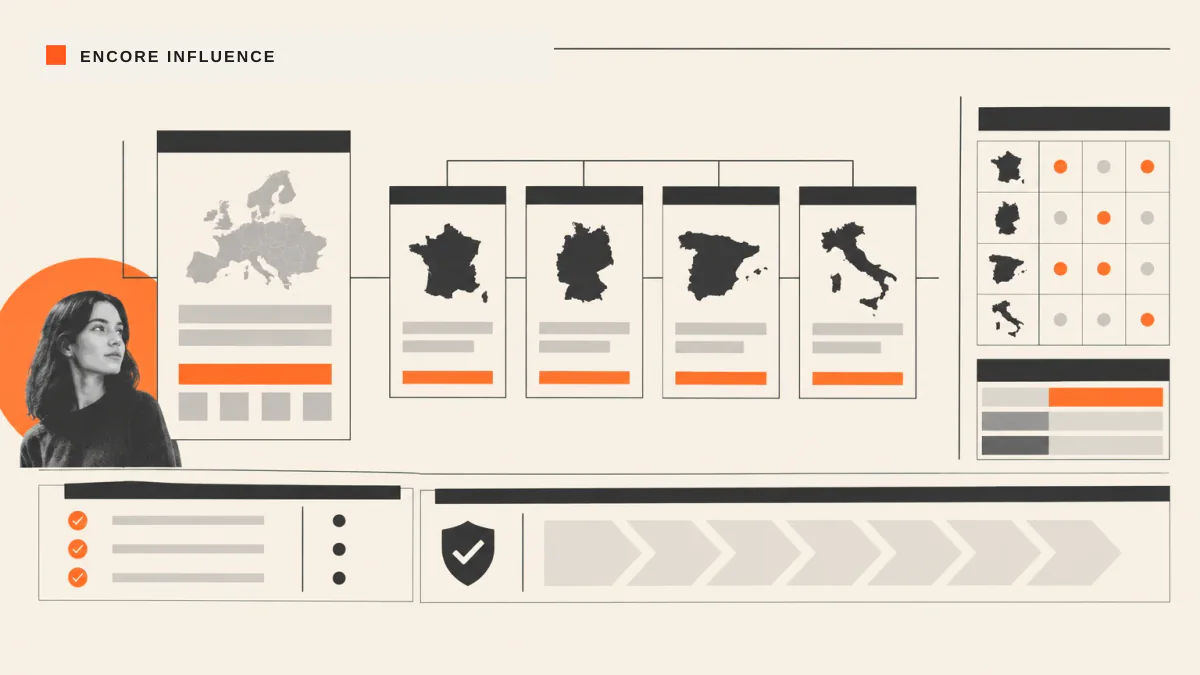
If you are a Chinese brand planning a creator campaign across several European countries, do not treat Europe as one market. The most reliable way to run the work is to separate four layers from the beginning:
- Language — which language each creator should use, and whether one country needs more than one language version.
- Market — which countries are in scope, why they are included, and what role each country plays in the regional plan.
- Platform — which platforms are used in each country, because the disclosure workflow differs by platform.
- Disclosure — how branded content is labeled, reviewed, and approved before posting.
That separation matters because the same campaign can fail operationally even when the creative idea is strong. A creator may be right for France but wrong for Germany. A brief may be culturally acceptable in one market but awkward in another. And a branded post may be on-message but still need to follow a specific disclosure workflow on TikTok or YouTube.
The practical answer is to build one regional strategy and multiple local executions.
A useful operating model looks like this:
- Set a regional objective: awareness, consideration, traffic, content acquisition, or always-on creator coverage.
- Choose countries based on business priority, not on “Europe” as a single label.
- Map each country to its primary languages, creator categories, and likely platforms.
- Write one master brief, then produce country-specific versions.
- Build disclosure review into the approval process before publication.
- Report results by country and platform, not as one blended European number.
This is also where platform rules need to be treated as operational gates, not afterthoughts. TikTok requires creators posting branded content to turn on the commercial content disclosure setting Source 2. TikTok also says exact legal requirements may vary by country Source 2. YouTube requires creators to use the paid promotion button for branded content, sponsorships, endorsements, or other commercial relationships Source 3. YouTube says the disclosure label appears at the beginning of the video Source 3, and creators and partners are responsible for complying with applicable legal requirements Source 3.
So the short version is: separate language, market, and disclosure before you scale.
A practical framework for multi-country European creator campaigns
Use this six-step framework when you move from planning to execution.
1) Define the European role of each market
Start by deciding why each country is included.
Do not put every European country into the same plan just because the brand wants “Europe coverage.” Instead, assign a role to each market:
- Launch markets for first-wave awareness
- Validation markets for testing message, offer, or creator format
- Scale markets for repeatable content and efficient volume
- Support markets for niche audiences, creator seeding, or localized proof
This prevents the common mistake of spreading budget evenly across countries that do not play the same role. A market that is meant to validate message fit should not be measured by the same standards as a market meant to deliver volume.
2) Build a language matrix, not a single brief
A European campaign often looks simple at the brand level and complicated at execution level. Language is one of the main reasons.
Your matrix should show:
- Country
- Primary language(s)
- Secondary language option if relevant
- Creator native language requirement
- Caption/subtitle requirement
- Approval owner for language review
This avoids the “translated but not localized” problem. Translation alone is not enough if the creator’s tone, references, or examples feel unnatural in the target country.
3) Create separate creator pools by market and format
A creator who works well in one country may not work in another, even if the audience category is similar. Build pools by:
- Country
- Language
- Category authority
- Content format fit
- Audience geography
- Commercial comfort level
If you are working across several countries, do not rely on a single pan-European shortlist. Use local sourcing, local vetting, and local fallback options. This is especially important when a broad product mix needs multiple creator styles.
Approved Encore case evidence supports this type of operating logic. In the TEMU multi-market creator activation program, Encore Influence supported an always-on program across the United States, Germany, France, and Canada, and local creators produced content for TikTok, Instagram, YouTube, Snapchat, and Facebook Source 1. The approved case record reports 100M+ total views, 40+ monthly content pieces, 100+ cumulative creators, and 200K+ engagements Source 1. That is not a guarantee for your campaign, but it does show the value of local creator selection inside a centralized operating system.
4) Standardize the operating workflow, not the creative output
The strongest multi-country teams standardize the workflow while allowing the creative output to vary by country.
Standardize:
- Creator sourcing criteria
- Contracting process
- Rights language
- Content submission deadlines
- Disclosure checklist
- Review and escalation steps
- Reporting structure
Localize:
- Language
- Cultural references
- Creator style
- Product proof points
- CTA phrasing
- Platform emphasis
This balance matters because if you standardize the creative too aggressively, you lose local relevance. If you localize everything without a common process, the campaign becomes impossible to manage.
5) Treat disclosure as part of QA, not a legal footer
For creator campaigns, disclosure is not just a compliance checkbox. It affects whether the content is approved, publishable, and platform-ready.
Use a disclosure checklist before every post goes live:
- Does the platform require a specific branded content disclosure?
- Has the creator enabled it correctly?
- Does the label appear in the correct position or format?
- Does the content language match the local market requirement?
- Has the legal or compliance reviewer signed off where needed?
On TikTok, proper disclosure does not affect recommendation performance, according to TikTok’s guidance Source 2. But undisclosed commercial content may become ineligible for For You distribution Source 2. On YouTube, the paid promotion label appears at the beginning of the video Source 3.
That means your team should never leave disclosure to the last minute. The correct approach is to build it into the brief, the creator checklist, and the final approval flow.
6) Report by market, platform, and creator cohort
Do not let one blended European dashboard hide the real story.
At minimum, your reporting should separate:
- Country
- Platform
- Creator type
- Content format
- Organic vs paid support if applicable
- Disclosure status
- Content acceptance rate
- Top-performing local angles
This lets you learn whether the issue is market fit, language fit, creator fit, or platform fit.
What to localize country by country
The word “localize” is often used too loosely. For a European creator campaign, these are the elements most likely to need local adjustment:
- Language: formal vs casual tone, caption style, slang, and subtitle needs
- Proof points: which product claims or benefits matter most locally
- Creator identity: age, lifestyle, niche, and audience trust signals
- Content pacing: how quickly the creator gets to the product message
- Disclosure execution: platform-specific label placement and format
- Rights scope: where the content can be reused, and in which countries
- Comment moderation: local language monitoring after publishing
Some brands try to solve everything with one pan-European influencer roster. That can work only for a narrow use case. If the campaign is intended to scale, you usually need a layered roster: one group for regional leadership, one group for each priority country, and one reserve pool for replacements or testing.
A simple operating checklist
Before launch, confirm the following:
- Each country has a defined role in the campaign
- Each market has language coverage
- Creator pools are separated by country and content format
- Platform disclosure requirements are mapped by channel
- The approval workflow includes legal or compliance review where needed
- Rights scope is clear for each asset
- Reporting templates separate market, platform, and creator results
- Backup creators are available for each priority market
- The team knows who owns escalation if a disclosure issue appears late
How the approved case evidence fits
Approved Encore case evidence is useful because it shows what multi-market execution can look like in practice.
The SHEIN case shows an always-on fashion creator program spanning more than 30 markets, focused on finding untapped creators, checking prior brand collaboration, and managing outreach, seeding, briefing, and reporting Source 1. The approved case record reports 100+ creators, 10M+ total views, and 100+ published content pieces Source 1.
The SHEGLAM case shows product-specific creator partnerships across 10 markets, with creators matched by product suitability, audience credibility, and cost efficiency Source 1. The approved case record reports an actual CPM of 15 or lower, 25% below the target CPM, with 310K+ views and 20K+ engagement on the top-performing video Source 1.
These cases do not prove a guaranteed result for your European campaign. They do show a consistent pattern: multi-market success depends on local creator selection, clear operating rules, and disciplined review.
The main mistake to avoid
The biggest mistake is to confuse “regional planning” with “one-size-fits-all execution.”
A European campaign should not be designed around the easiest internal workflow. It should be designed around the realities of local language, local platform behavior, and local disclosure requirements. If you skip that step, you may still publish content, but you will likely spend more time fixing avoidable errors, rebriefing creators, or cleaning up compliance issues.
The better model is slower at the start and faster at scale:
- slower because you define the market architecture properly,
- faster because creators, reviewers, and local teams all know the rules.
Methodology and Limitations
This article was built from three verified source types only: TikTok’s commercial content disclosure guidance, YouTube’s branded content disclosure guidance, and approved Encore case evidence showing multi-market creator execution.
The methodology used here is:
- Extract the verified platform rules and disclosure statements.
- Use the approved case evidence to understand how multi-market execution is structured in practice.
- Translate those inputs into a practical operating framework for Chinese brands planning European creator campaigns.
- Avoid claiming any European country-specific legal rule unless it is directly supported by source evidence.
Limitations:
- TikTok states that exact legal requirements may vary by country Source 2, so this article cannot replace local legal advice.
- YouTube states that creators and partners are responsible for complying with applicable legal requirements Source 3, so legal review may still be needed depending on the country and campaign structure.
- Approved Encore case evidence is operational proof, not legal proof. It shows what has been done in approved campaigns, not what every European market allows or requires.
- Performance figures in the case evidence are historical records from approved case files, not projections for future campaigns.
Frequently Asked Questions
Do I need a separate campaign for every European country?
Not necessarily, but you usually need separate execution layers. One regional strategy can support multiple countries, yet each market often needs its own language plan, creator shortlist, disclosure workflow, and reporting view.
Can I use the same creator brief in France and Germany?
You can use the same master objective, but the brief should usually be localized. The message, examples, tone, language, and disclosure handling should be adapted to the country and platform.
Is TikTok disclosure mandatory for branded content?
TikTok says creators posting branded content need to turn on the commercial content disclosure setting Source 2. TikTok also says exact legal requirements may vary by country Source 2.
Is YouTube disclosure the same as TikTok disclosure?
No. YouTube requires creators to use the paid promotion button for branded content, sponsorships, endorsements, or other commercial relationships Source 3. The label appears at the beginning of the video Source 3.
Does proper disclosure hurt reach?
TikTok says proper disclosure does not affect recommendation performance Source 2. However, TikTok also says undisclosed commercial content may become ineligible for For You distribution Source 2.
What is the most useful internal document for a multi-country European creator campaign?
A market matrix. It should show country, language, platform, creator pool, disclosure rule, approval owner, and reporting method in one place.
What should I do first if I am entering Europe for the first time?
Start with market selection and language mapping before creator outreach. If you do not know which countries are in scope and who will review disclosure, content approval becomes hard to manage later.
What does Encore case evidence show about multi-market execution?
Approved Encore case evidence shows local creator execution across several countries and platforms, including a TEMU program across the United States, Germany, France, and Canada Source 1. It also shows multi-market fashion and beauty creator programs at larger scale Source 1.
Conclusion
For Chinese brands, the right way to plan a multi-country European creator campaign is to separate language, market, and disclosure from day one. Europe is not one audience, and the platform rules you must follow are not identical across channels. TikTok and YouTube both provide explicit branded-content disclosure guidance Source 2Source 3, and approved Encore case evidence shows that multi-market creator systems work best when central governance is paired with local execution Source 1.
If you want a campaign that is easier to run, easier to approve, and easier to learn from, build the matrix first, then scale the creators.
Verified Sources
+FAQ
Overseas creator discovery, answered clearly.
01Is Europe a single influencer market?+
No. For campaign operations, it is safer to treat Europe as a cluster of separate markets. The practical differences are language, creator pool depth, platform usage, disclosure practice, and local commercial expectations. A regional plan should standardize governance while allowing country-level execution.
02Do I need different disclosure rules for each platform?+
Yes, you should assume platform-specific disclosure workflows. TikTok requires creators posting branded content to turn on the commercial content disclosure setting [[SOURCE:src_4537c6961526]]. YouTube requires the paid promotion button for branded content, sponsorships, endorsements, or other commercial relationships [[SOURCE:src_d41d53bb06f4]].
03Can proper disclosure hurt campaign performance?+
TikTok says proper disclosure does not affect recommendation performance [[SOURCE:src_4537c6961526]]. However, undisclosed commercial content may become ineligible for For You distribution on TikTok [[SOURCE:src_4537c6961526]]. That is a platform guidance statement, not a guarantee of delivery or performance.
04How should Chinese brands organize a multi-country European creator campaign?+
Use one central operating model with local market layers. In practice, that means a shared brief architecture, a country-by-country creator matrix, local language review, local disclosure checks, and reporting that separates market outcomes instead of merging them into one blended number.
05Can one creator brief work across multiple European countries?+
A single high-level objective can work, but the execution brief usually cannot be identical everywhere. The message, examples, legal disclosures, creator usage rights, and deliverables should be adjusted for each market and platform.
06What does approved Encore case evidence show about multi-market execution?+
The approved TEMU case record shows Encore Influence supported an always-on creator activation program across the United States, Germany, France, and Canada, with local creators producing content for TikTok, Instagram, YouTube, Snapchat, and Facebook [[SOURCE:src_0972d0d10496]]. That demonstrates multi-market operating capability, not a universal template for Europe.
+Methodology
This guide combines three verified inputs: TikTok’s disclosure guidance, YouTube’s branded content disclosure guidance, and approved Encore case evidence showing multi-market creator execution. The analysis below uses those facts to build an operating model for Chinese brands planning creator campaigns across several European countries. Where the article discusses structure, workflow, or planning advice, it is practical analysis rather than a claim about any specific platform rule or legal requirement. The goal is to help teams separate what must be standardized regionally from what must be localized by country, language, platform, and creator relationship.
+Limitations
Europe is not one legal or creator market. Disclosure obligations, consumer expectations, contract norms, and platform behavior can differ by country, so this article does not provide country-by-country legal advice. TikTok explicitly says exact legal requirements may vary by country [[SOURCE:src_4537c6961526]]. YouTube also states that creators and partners are responsible for complying with applicable legal requirements [[SOURCE:src_d41d53bb06f4]]. Approved Encore case evidence demonstrates multi-market execution capability, but it does not establish European legal rules or guarantee similar outcomes in every campaign. Any performance figures in the case evidence are historical approved records, not predictions.
+Source basis
- TikTok Ads, About the Commercial Content Disclosure setting for creators, announced 2026-04-01: https://ads.tiktok.com/resources/help/article/about-the-content-disclosure-setting-for-creators
- YouTube Help, Add branded content restrictions & disclosure labels, publication date not stated: https://support.google.com/youtube/answer/154235
- Approved Encore case, TEMU multi-market creator activation, publication date not stated: https://www.encoreinfluence.com/en/cases/temu-multi-market-creator-activation