+Influencer Marketing / Creator Risk Review
How to Vet Creators for Brand Safety, Audience Quality, and Collaboration Risk Before Outreach
+Key takeaways
The short answer.
A practical pre-contract checklist for brand teams that already have shortlisted creators and need to screen brand safety, audience quality, disclosure compliance, and collaboration risk before outreach or contracting.
- Key point / 01Use a two-step screen: first eliminate clear brand-safety and compliance risks, then compare audience quality and collaboration fit among the remaining creators.
- Key point / 02Check whether creators follow disclosure rules on the platforms you plan to use, including TikTok commercial content disclosure and YouTube’s advertising policy requirements. [[SOURCE:src_4537c6961526]] [[SOURCE:src_b294ccb63b13]]
- Key point / 03Review audience quality with a focus on geography, relevance, consistency, and likely fit to your category rather than vanity metrics alone.
- Key point / 04Look for collaboration signals such as posting discipline, comment quality, prior brand partnerships, and whether the creator’s style can support your brief without major rewrites.
- Key point / 05Escalate any creator with unclear sponsorship history, repetitive spam-like audience patterns, or content that conflicts with your brand standards before you enter negotiation.
Direct Answer
If your brand already has a shortlist, the safest way to vet creators is to treat screening as a governance process, not a popularity contest.
The question is not only “Can this creator perform?” It is also “Can we work with this creator without creating compliance, reputation, or workflow problems?” That means your review should cover three layers:
- Brand safety — does the creator’s content, tone, and association history fit your standards?
- Audience quality — does the creator reach the right people in the right places?
- Collaboration risk — can the creator reliably follow disclosure, approval, timing, and usage requirements?
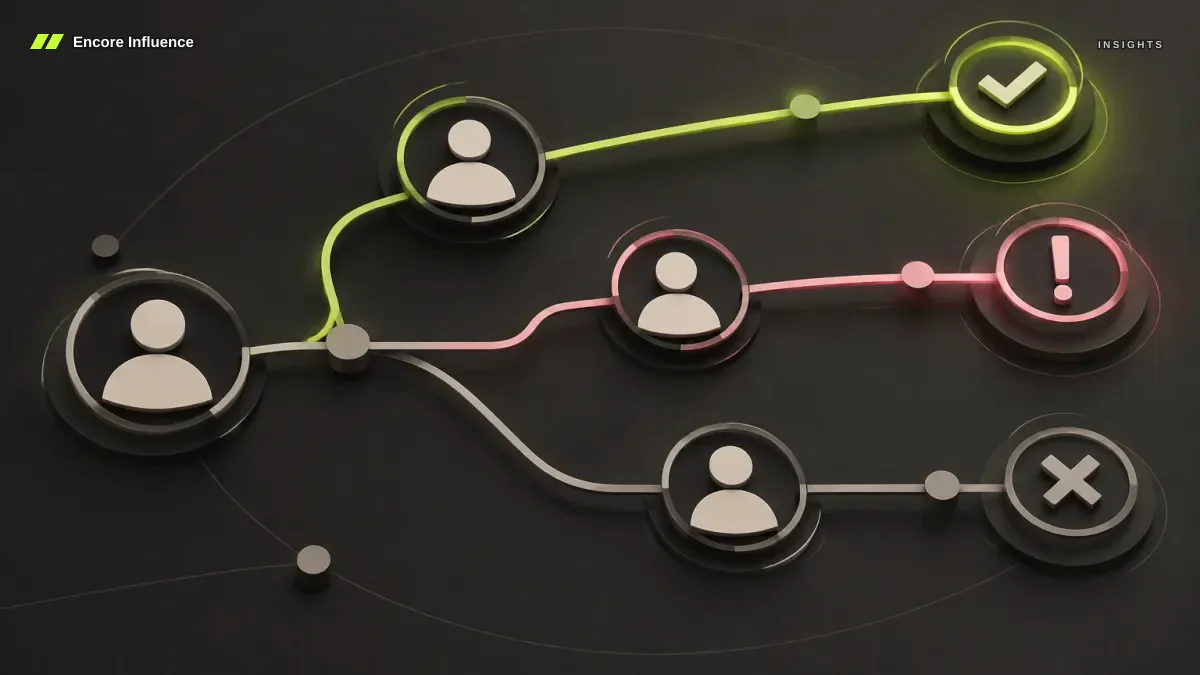
A practical vetting process has four steps:
1) Remove obvious no-go risks first
Look for anything that would make the creator hard to approve internally. Examples include obvious category conflicts, inconsistent sponsorship behavior, or content themes that do not fit your brand rules. If a creator raises a serious question in the first pass, do not spend time optimizing the brief before the risk is resolved.
2) Check disclosure and policy alignment
This is a non-negotiable baseline. TikTok requires commercial content disclosure for branded content and notes that legal requirements may vary by country. Source 1 YouTube says paid product placements or endorsements must comply with advertising policies and applicable legal and regulatory obligations. Source 2 The FTC also provides guidance for endorsements, influencers, and reviews and directs marketers to its disclosures guidance and revised 2023 Endorsement Guides. Source 3
For brands, that means you should ask:
- Has the creator handled sponsored content transparently before?
- Do they use disclosure language consistently?
- Are they likely to comply with your internal approval and legal review process?
3) Evaluate audience quality beyond vanity metrics
Follower count alone is not enough. A creator can have a large following and still be a poor fit if the audience is in the wrong market, the wrong age band, or the wrong category mindset.
For an operational review, check:
- Audience geography: Do the creator’s viewers align with your launch market?
- Category relevance: Does the audience appear genuinely interested in your product type?
- Engagement quality: Are comments thoughtful and relevant, or repetitive and low-value?
- Content consistency: Does the audience respond to a stable style, or does performance swing wildly without explanation?
The best signal is not raw reach. It is whether the creator consistently attracts the type of attention your brand needs.
4) Test collaboration fit before contracting
A creator can be safe on paper and still be difficult to work with. Review their collaboration behavior as seriously as their content.
Useful checks include:
- How clearly they present deliverables in past partnerships
- Whether they publish on time
- Whether they adapt to product claims and brand rules
- Whether their content style can carry your message without major rewrites
- Whether they have a track record of working across briefs, not only one-off posts
This is especially important when you need a repeatable content pipeline. In approved Encore case work, creator selection often focused on content already demonstrating product clarity and audience response, then evaluated fit for category, native storytelling quality, and distribution suitability before rights or further activation. See the TEMU content-acquisition case for an example of performance-led screening and rights readiness: /en/cases/temu-us-content-acquisition
A simple pre-outreach vetting framework
You do not need a complex model to make better decisions. A strong shortlist review can use five yes-or-no questions:
- Does the creator’s content fit our brand safety standards?
- Is sponsorship disclosure visible and consistent where required?
- Does the audience match our target market and category?
- Have they shown stable collaboration behavior before?
- Would we be comfortable putting this creator through legal, procurement, and approval review?
If the answer is “no” to any of these, either escalate or remove the creator.
If the answer is “yes” but with concerns, move the creator into a review lane instead of an immediate outreach lane. That keeps the team from mixing high-potential talent with unresolved risk.
What to document before outreach
Before anyone sends a message, write down the reason the creator passed. Keep the record short and practical:
- Brand safety notes
- Audience fit notes
- Disclosure/compliance notes
- Collaboration-risk notes
- Any internal escalation required
This protects the team later when procurement, legal, or senior leadership asks why the creator moved forward.
It also makes later negotiation easier. If you know why the creator is a fit, you can build a better brief, set cleaner expectations, and reduce back-and-forth.
When brand teams should escalate
Escalation is appropriate when the creator is interesting but not yet ready for direct outreach. Common escalation triggers include:
- Unclear sponsorship disclosure behavior
- Content topics that may conflict with brand standards
- Audience signals that do not match the target market
- Prior collaboration history that is hard to verify
- A style or tone that would require unusually heavy brand control
In mature programs, escalation is not a rejection. It is a risk-management step. It allows the team to decide whether the creator needs legal review, more evidence, or a different campaign role.
A practical rule for brand teams
If a creator only looks good on reach, pause.
If a creator looks good on reach and audience quality but weak on disclosure or workflow discipline, escalate.
If a creator looks strong across brand safety, audience fit, and collaboration reliability, they are ready for outreach or contracting.
For teams building that discipline into a broader program, these internal resources can help:
- /en/insights/influencer-marketing-contract-checklist
- /en/insights/influencer-brief-content-approval-workflow
- /en/services/influencer-marketing
Methodology and Limitations
This guidance is based on a practical shortlist-review workflow for brand teams. It uses only the verified external facts supplied here for disclosure and policy context. TikTok requires commercial content disclosure for branded content and notes that legal requirements may vary by country. Source 1 YouTube requires paid product placements or endorsements to comply with advertising policies and applicable legal and regulatory obligations. Source 2 The FTC provides staff guidance for endorsements, influencers, and reviews and points marketers to its disclosures guidance and revised 2023 Endorsement Guides. Source 3
Limitations: this article does not claim a complete fraud-detection method, a legal opinion, or a universal scoring model. It is designed to help teams narrow a shortlist and decide what to approve, escalate, or remove before outreach or contracting.
Frequently Asked Questions
How do I know if audience quality is good enough?
Audience quality is “good enough” when the creator’s viewers match your target market closely enough that the partnership makes strategic sense. Look for relevance, geography, consistency, and engagement quality. If the audience is broad but unfocused, or active but mismatched, the creator may still be a poor fit.
Should brand safety be checked before audience quality?
Yes. Brand safety and compliance should come first because they are potential deal-breakers. A creator with the right audience is still risky if their content, disclosures, or sponsorship habits create approval problems.
What is the fastest way to reduce collaboration risk?
Use a standard checklist before outreach: verify disclosure history, review prior partnerships, check content consistency, and confirm that the creator can work within your brief and approval process. That simple discipline filters out many operational issues before negotiation starts.
Can a creator be approved even if some risk remains?
Yes, but only if the risk is understood and escalated. Some creators need extra legal review, tighter briefing, or narrower usage rights before they are safe to contract. The goal is not to find perfect creators; it is to make informed decisions with clear documentation.
Final recommendation
For shortlist vetting, keep the process simple: eliminate obvious safety risks, confirm disclosure alignment, assess audience quality, and judge whether the creator can work cleanly inside your approval system. If you do that consistently, your outreach list becomes smaller, safer, and easier to contract.
Verified Sources
+FAQ
Overseas creator discovery, answered clearly.
01What should be checked first when a creator is already shortlisted?+
Start with high-risk filters: sponsored-content disclosure history, obvious brand conflicts, and anything that would make the creator difficult to contract or approve internally. After that, review audience quality and collaboration history. This order matters because a creator with a good-looking profile can still fail on compliance or governance.
02How do platform rules affect creator vetting?+
They set the minimum compliance standard. TikTok requires commercial content disclosure for branded content and notes that legal requirements may vary by country. YouTube says paid product placements or endorsements must comply with advertising policies and applicable legal and regulatory obligations. The FTC also provides staff guidance for endorsements, influencers, and reviews and points marketers to its disclosures guidance and revised 2023 Endorsement Guides. [[SOURCE:src_4537c6961526]] [[SOURCE:src_b294ccb63b13]] [[SOURCE:src_d0e596db34b2]]
03What audience signals matter more than follower count?+
For a pre-contract review, focus on audience relevance, geography, consistency, engagement quality, and whether the creator’s content attracts the kind of buyer or viewer your brand actually wants. A smaller but more aligned audience is often easier to work with than a large audience that does not match the brief.
04When should a creator be escalated instead of approved?+
Escalate if you cannot verify sponsorship history, if disclosure practices look weak, if the audience appears inconsistent with the creator’s niche, or if the content tone conflicts with your brand rules. Escalation is also appropriate when the creator requires special legal, reputation, or usage-rights review before any outreach.
+Methodology
This article is a practical screening framework for brand teams that already have a shortlist. It combines governance checks, audience-quality review, and collaboration-risk assessment. The recommendations below are operational guidance, while platform and regulatory notes are limited to the verified facts supplied by the FTC, TikTok, and YouTube. The goal is to help teams decide who to advance to outreach, who to escalate, and who to remove before contracting.
+Limitations
This is not a fraud-detection guarantee, a legal opinion, or a substitute for platform-specific compliance review. The verified sources confirm disclosure and advertising-policy obligations, but they do not provide a complete scoring model for audience authenticity or creator fraud. Any country-specific legal requirement should be checked locally, because TikTok notes that legal requirements may vary by country. [[SOURCE:src_4537c6961526]]
+Source basis
- Federal Trade Commission, Endorsements, Influencers, and Reviews, publication date not stated: https://www.ftc.gov/business-guidance/advertising-marketing/endorsements-influencers-reviews
- TikTok Ads Help, About the Commercial Content Disclosure setting for creators, publication date not stated: https://ads.tiktok.com/resources/help/article/about-the-content-disclosure-setting-for-creators
- YouTube Help, Embedded third-party sponsorships and ads in YouTube content, publication date not stated: https://support.google.com/youtube/answer/3364658