+Evergreen Insight
Influencer Outreach and Negotiation: A Practical Workflow for Global Campaigns
+Key takeaways
The short answer.
A practical workflow for Chinese brand and agency teams that need to move from a qualified creator shortlist to outreach, follow-up, fee, scope, rights and disclosure decisions in global campaigns.
- Key point / 01Start outreach only after qualification is complete: creator fit, audience fit and platform fit should already be clear before the first message.
- Key point / 02Use a simple global workflow: open with relevance, follow with a specific ask, then negotiate scope, deliverables, usage rights and timing in that order.
- Key point / 03Keep disclosure and compliance separate from commercial negotiation: the creator must still make clear disclosures of material brand connections.
- Key point / 04Treat follow-up as a system, not a reminder: timing, channel and escalation should be defined before you contact any creator.
- Key point / 05Use market- and platform-specific notes for YouTube and TikTok because search, insight and availability rules differ by tool and region.
Direct Answer
The most effective way to turn a qualified overseas creator shortlist into signed partners is to run outreach as a sequence, not a single message.
First, make sure qualification is complete. By the time you send the first email or DM, you should already know why the creator fits the brief, what audience they reach, and which platform behavior makes them relevant. TikTok One supports discovery in the Explore creators area, with search by username or keyword, plus filters for creator details, audience details and performance metrics Source 3. Creator profiles can show performance analytics, audience insights, content portfolios and collaboration evaluation scores Source 3. YouTube Creator Partnerships Creator Search also supports keyword or channel-handle search, filters, creator insights, sample videos, list management and creator comparison, but only in locations where the YouTube Partner Program is active Source 2.
Second, use a message that is short, specific and easy to answer. The purpose of the first outreach is not to negotiate every term. It is to get a response quickly and confirm whether the creator is open to the opportunity. A strong opening message usually covers four things: why the creator was chosen, what the campaign is about, what kind of collaboration you want, and what the next step is.
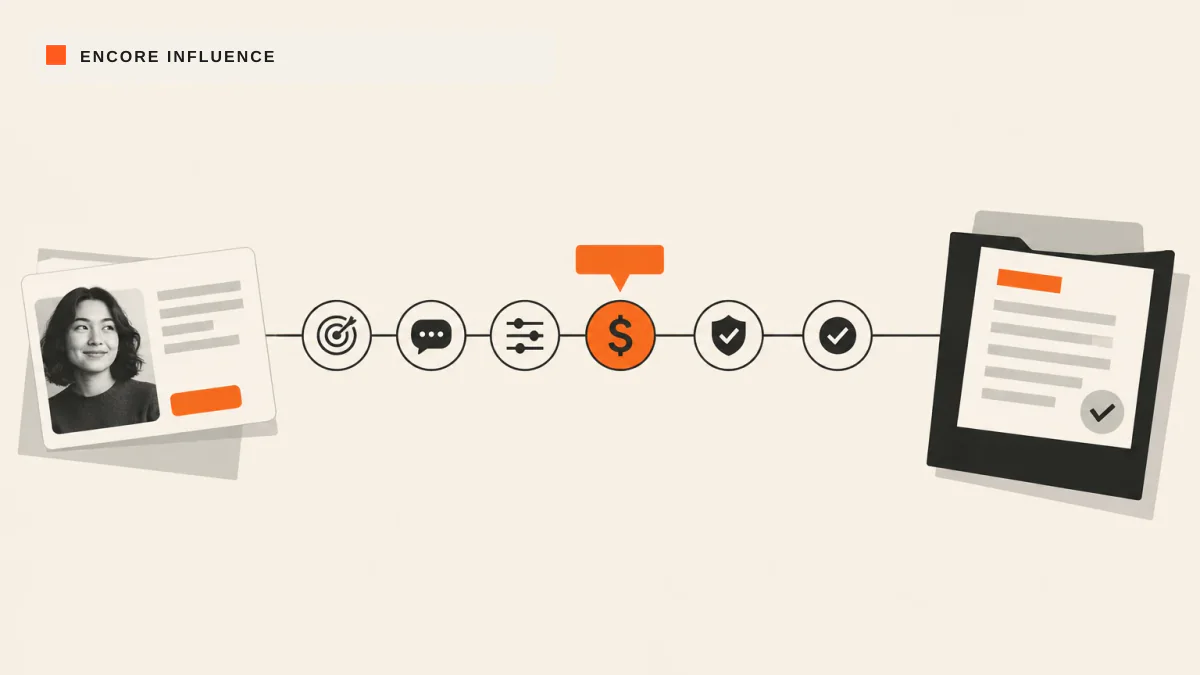
Third, move in order: interest, scope, fee, rights, timing, then handoff. Many teams fail because they try to discuss too many things at once. When that happens, creators either ignore the message or respond with broad pricing before the brand has clarified the commercial value. A cleaner flow is: establish relevance, confirm fit, share the deliverables, negotiate compensation, confirm usage and disclosure expectations, then transfer the approved terms into briefing and production.
Fourth, keep disclosure visible from the start. FTC guidance says influencers are responsible for clear disclosures of material connections to brands, and the disclosures must be visible and understandable across formats Source 1. That means disclosure is not a late-stage compliance note. It is part of the commercial process, because the creator needs to know how the partnership will be disclosed before publication.
In short: the winning workflow is not "contact more creators." It is "contact fewer, better-qualified creators with a clear ask, a clear follow-up plan and a clear commercial path to approval."
A Practical Global Outreach Workflow
1) Build the outreach list from qualified signals, not from volume
Your outreach list should be the output of screening, not the starting point. For global campaigns, screen by market relevance, content style, audience fit, category alignment and platform fit. Then decide which creators deserve custom outreach and which can stay in reserve.
Useful screening questions include:
- Does the creator already make content in the category or adjacent category?
- Does the audience geography match the target market?
- Does the creator’s tone fit the brand’s positioning?
- Is the creator active on the platform where the campaign will run?
- Does the creator’s content format support the required deliverables?
TikTok One and YouTube Creator Partnerships both provide search, filters and profile-level review signals that can support this screening stage Source 3 Source 2.
2) Write the first message around relevance and response speed
The first outreach message should be easy to scan on mobile. Keep it brief and personalized. Avoid a long brand introduction unless the creator genuinely needs it.
A useful structure is:
- Who you are
- Why you reached out to this creator specifically
- What the collaboration would involve at a high level
- What you want them to do next
Operationally, this is the best time to reduce friction. If you can ask a simple yes/no question, do that. If you need a rate card, ask for it directly. If you need to know whether they can meet a certain timeline, ask early.
3) Use follow-up as a process, not an improvisation
Many teams follow up too late, too often or in inconsistent ways. Instead, define a cadence before launch. A practical pattern is:
- Initial outreach
- One follow-up after a sensible waiting period
- One final check-in before closing the loop
There is no verified universal cadence in the supplied sources, so do not treat any single number as a rule. What matters is that the cadence is consistent across markets and that internal owners know when a lead is active, warm, cold or closed.
Helpful follow-up rules:
- Reply in the creator’s language when possible.
- Keep the thread focused on one decision at a time.
- Do not attach a long brief before the creator has shown interest.
- If the creator is interested but slow, restate the decision needed and the deadline.
- If there is no response after the final follow-up, close the loop and move on.
4) Negotiate in the right order
Negotiation often becomes messy because teams jump from fee to usage rights to deliverables to exclusivity to timing in one message. That creates confusion and makes the creator feel pressured.
A better order is:
- Confirm interest and availability
- Confirm the deliverables and content format
- Confirm fee or compensation structure
- Confirm usage rights and territory if content will be reused
- Confirm posting timeline and review process
- Confirm disclosure language and compliance expectations
This order is not a legal rule; it is an operational simplification that helps both sides reach agreement faster.
5) Separate creative scope from commercial scope
For international campaigns, one of the most useful discipline changes is to separate what the creator will make from how the brand may use it.
Creative scope answers:
- What content will be produced?
- How many deliverables?
- Which formats?
- Which markets?
- Which publishing windows?
Commercial scope answers:
- What is the fee?
- Can the brand reuse the content?
- For how long?
- In which channels?
- Is the content limited to organic use or can it support paid media?
Approved Encore case evidence shows why this distinction matters. In the TEMU US content acquisition program, Encore Influence supported creator rights negotiation and prepared selected content for an always-on Instagram Reels pipeline. The approved case record reports 1,000+ sourced assets across 6+ months, 260+ peak monthly volume and 500M+ total Reels views [[SOURCE:approved-case-temu-us-content-acquisition]]. That is a strong reminder that rights negotiation is not just an admin step; it can determine whether a campaign can continue to generate value after the first post.
6) Make disclosure a standard line item, not a special exception
FTC guidance is clear that influencers are responsible for making clear disclosures of material connections to brands, and that disclosures must be visible and understandable across formats Source 1. For that reason, include disclosure in your outreach or at least in your early commercial confirmation.
A practical workflow is:
- Mention disclosure expectations early
- Confirm the required label or phrasing during briefing
- Review the creator’s draft for visibility and clarity
- Avoid burying disclosures in a caption’s long tail or in a hard-to-see location
This is especially important in multi-format work, because disclosure placement can differ between video, image, live content and short-form captions.
7) Hand off cleanly into briefing and production
Once the creator accepts the terms, the handoff should be immediate and unambiguous. Don’t let agreement sit in inboxes.
Your handoff pack should include:
- Final deliverables
- Fees and payment timing
- Usage rights summary
- Posting dates or windows
- Review and approval steps
- Disclosure instructions
- Contact person for questions
This is also where your internal team should capture any market-specific notes, such as language requirements, local holidays, platform formatting differences or regional review constraints.
A Simple Checklist for Global Teams
Use this before every creator outreach wave:
- Shortlist is already qualified by market, category and platform fit
- Outreach owner is assigned
- First message is personalized and short
- Follow-up cadence is defined before sending
- Fee discussion is separated from rights discussion
- Usage rights needs are written down in advance
- Disclosure expectations are included early
- Handoff template is ready for accepted creators
- Local language and time-zone rules are clear
- Platform availability has been checked for the market
What Good Looks Like in Practice
Approved Encore case evidence shows the value of a repeatable outreach and negotiation system.
In the SHEIN global fashion creator program, Encore Influence supported an always-on creator program spanning more than 30 markets. The work focused on finding untapped creators, checking prior brand collaboration and managing outreach, seeding, briefing and reporting. The approved case record reports 100+ creators, 10M+ total views and 100+ published content pieces [[SOURCE:approved-case-shein-global-fashion-creators]].
In the TEMU multi-market creator activation program, Encore Influence supported an always-on creator program across the United States, Germany, France and Canada, with local creators producing content for TikTok, Instagram, YouTube, Snapchat and Facebook. The approved case record reports 100M+ total views, 40+ monthly content pieces, 100+ cumulative creators and 200K+ engagements [[SOURCE:approved-case-temu-multi-market-creator-activation]].
In the SHEGLAM multi-market beauty program, creators were matched by product suitability, audience credibility and cost efficiency across 10 markets. The approved case record reports an actual CPM of 15 or lower, 25% below the target CPM, with 310K+ views and 20K+ engagement on the top-performing video [[SOURCE:approved-case-sheglam-multi-market-beauty]].
These case records do not prove a single universal formula. They do show a common pattern: teams get better results when outreach is specific, negotiation is structured and commercial handoff is controlled.
Methodology and Limitations
Methodology
This article is built from three verified external sources and approved Encore case evidence.
- TikTok One creator discovery guidance supports the discovery and profile-review stage, including search by username or keyword, filters and creator profile analytics Source 3.
- YouTube Creator Partnerships Creator Search supports creator search, filters, insights, sample videos, list management and creator comparison in locations where the YouTube Partner Program is active Source 2.
- FTC guidance establishes that influencers are responsible for clear disclosures of material connections and that disclosures must be visible and understandable across formats Source 1.
- Approved Encore cases illustrate how outreach, rights negotiation, briefing and reporting can work across markets and platforms, including always-on creator activation and content acquisition.
Limitations
The external sources do not define the best outreach cadence, exact follow-up timing, or standard fee and contract language. Those parts of this article are operational recommendations, not regulatory or platform rules.
YouTube Creator Partnerships Creator Search is only available in locations where the YouTube Partner Program is active Source 2. TikTok One availability can depend on account and region Source 3. FTC guidance is U.S.-based and should not be assumed to cover every market’s local legal requirements Source 1.
Approved Encore case evidence is useful for understanding applied workflows, but it should not be interpreted as a guarantee of future results. Results vary by market, creator quality, category, platform behavior and commercial terms.
Frequently Asked Questions
How do we improve creator response rates in global outreach?
Lead with relevance. Creators respond more often when they can quickly see why they were chosen, what the collaboration involves and what decision you need from them. Keep the first message short and specific, and make the reply path easy.
Should we use email, DM or both?
Use the channel that best matches the creator’s public workflow. For many creators, an initial DM can be efficient, while email is better for formal negotiation and document exchange. A common operational pattern is to open on the channel where the creator is most reachable, then move to email once interest is confirmed.
What should we do if the creator asks for a rate before sharing details?
Share enough context to make the request fair. If the creator wants a rate first, give the core campaign facts: platform, market, deliverables, timeline and whether usage rights are required. That allows the creator to price accurately instead of guessing.
How early should we discuss usage rights?
As early as possible once the creator has shown interest. If content may be reused in paid media, in other markets or beyond the initial post, that should be part of the commercial conversation before briefing begins.
Do we need separate outreach templates for every market?
No, but you do need localization. The structure of the message can stay the same, while language, tone, timing and platform references should adapt to the market. You also need to respect platform availability and local creator behavior. For example, YouTube Creator Partnerships Creator Search is available only where the YouTube Partner Program is active Source 2.
Where should disclosure be handled in the process?
Treat disclosure as a standard part of the workflow, not a final checkbox. FTC guidance says disclosures must be clear, visible and understandable across formats Source 1. The simplest operational approach is to note disclosure expectations during negotiation and confirm exact placement during briefing.
Which internal links are most relevant next?
If you are still building the qualified shortlist, start with /en/insights/how-to-find-overseas-influencers. If you are ready to define content and approval steps, move to /en/insights/influencer-brief-content-approval-workflow. If the main issue is content reuse, use /en/insights/influencer-content-usage-rights-guide.
Next-Step Framework
If you want to operationalize this workflow, use this sequence:
- Finalize the shortlist.
- Prepare a personalized first message for each creator segment.
- Define a follow-up cadence before launch.
- Separate creative scope from commercial scope.
- Confirm rights and disclosure expectations before briefing.
- Create a clean handoff to content review and publishing.
For teams running multi-market campaigns, the main goal is consistency. When the process is repeatable, you can move faster without sacrificing negotiation quality or compliance discipline.
Related Resources
- How to Find Overseas Influencers
- Influencer Content Usage Rights Guide
- Influencer Brief and Content Approval Workflow
- SHEIN Global Fashion Creators
- TEMU US Content Acquisition
- TEMU Multi-Market Creator Activation
Call to Action
Need a repeatable creator outreach system for global campaigns?
If your team already has a shortlist but needs a better way to get responses, align fees, negotiate rights and hand work off cleanly, Encore Influence can help design the workflow, templates and commercial process around your markets and platforms.
Verified Sources
+FAQ
Overseas creator discovery, answered clearly.
01What should be finished before outreach begins?+
Before outreach, you should already have a qualified shortlist: the creator’s content style, audience fit, category relevance and platform fit should be clear enough that your first message is about business fit, not basic screening. TikTok One supports discovery and profile review through creator search, filters and performance metrics [[SOURCE:src_567b7e489d49]]. YouTube Creator Partnerships Creator Search supports keywords or channel handles, filters, creator insights and sample videos [[SOURCE:src_198b6505fdb6]].
02How many follow-ups should we send?+
There is no verified universal rule in the supplied sources. In practice, define a short, repeatable cadence before you start, such as an initial message, one follow-up after a reasonable interval, and one final check-in before you close the loop. The important part is consistency across markets and teams, not a fixed magic number.
03When should we discuss fee and usage rights?+
Discuss fee and usage rights after the creator has confirmed interest and after both sides agree on the basic content concept. This keeps the conversation focused and reduces back-and-forth. Approved Encore case evidence shows that rights negotiation can be part of the same commercial process as creator outreach when building content pipelines for reuse and distribution.
04Does disclosure belong in the outreach message?+
It can, but it should not be buried. FTC guidance says influencers are responsible for clear disclosures of material connections to brands, and disclosures must be visible and understandable across formats [[SOURCE:src_0a2d5f498ba5]]. In practice, it is sensible to remind the creator of disclosure expectations early, then confirm the exact on-post language and placement during briefing.
05Can we use the same outreach template for TikTok and YouTube?+
Use the same structure, not the same wording. TikTok One and YouTube Creator Partnerships expose different search and review surfaces, and availability differs by market and account status [[SOURCE:src_567b7e489d49]] [[SOURCE:src_198b6505fdb6]]. Your template should stay stable at the process level but adapt to the platform, language and local creator behavior.
+Methodology
This article translates verified platform guidance and regulator disclosure rules into an operational outreach workflow for global creator campaigns. The evidence base includes TikTok One creator discovery guidance, YouTube Creator Partnerships creator search guidance and FTC disclosure guidance. The article also uses approved Encore case evidence to ground the commercial handoff discussion in real creator recruitment, rights negotiation and always-on content pipelines. Where the sources support discovery, profile review and disclosure obligations, the article keeps to those verified facts. Where the article moves into outreach sequencing, negotiation structure and internal process design, those sections are clearly labeled as operational analysis rather than source-backed platform policy.
+Limitations
The verified sources support creator discovery, profile review and disclosure obligations, but they do not define best-practice outreach cadence, negotiation terms or contract language. YouTube Creator Partnerships Creator Search is available only in locations where the YouTube Partner Program is active [[SOURCE:src_198b6505fdb6]]. TikTok One discovery tools are described for the Explore creators area and availability can depend on account and region [[SOURCE:src_567b7e489d49]]. FTC disclosure guidance applies in the United States and does not replace local legal review in other markets [[SOURCE:src_0a2d5f498ba5]]. Approved Encore case evidence shows how outreach, rights negotiation and content handoff can work in practice, but it should not be treated as a universal guarantee of performance.
+Source basis
- TikTok for Business, How to find creators who work with TikTok One, announced 2026-11-01: https://ads.tiktok.com/resources/help/article/how-to-find-creators-who-work-with-tiktok-one
- Google Ads Help, How to navigate and use the Creator search tab in YouTube Creator Partnerships, announced 2026-06-01, effective 2026-06-01: https://support.google.com/google-ads/answer/16901401
- Federal Trade Commission, Disclosures 101 for Social Media Influencers, publication date not stated: https://www.ftc.gov/business-guidance/resources/disclosures-101-social-media-influencers