+Insight
Middle East Creator Marketing Market-Entry Framework for Chinese Brands
+Key takeaways
The short answer.
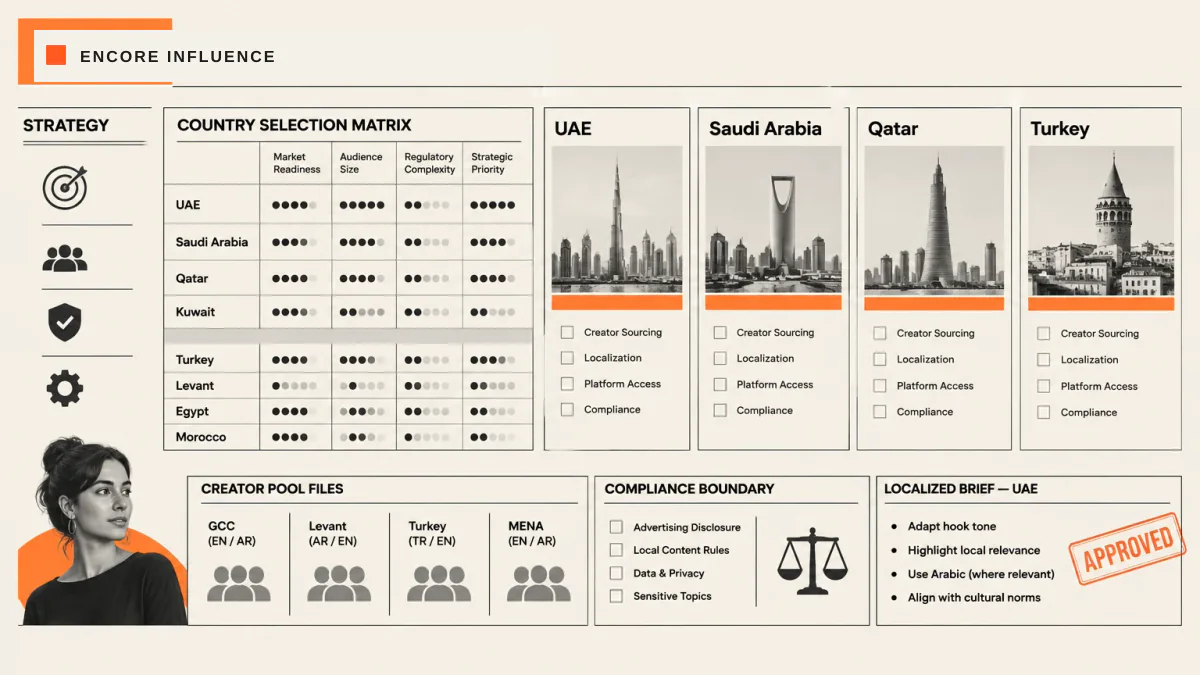
A practical framework for Chinese brands planning creator marketing in the Middle East, with separate operating decisions for market selection, localization, creator sourcing, platform boundaries and disclosure compliance.
- Key point / 01Treat the Middle East as a portfolio of distinct markets, not a single launch region.
- Key point / 02Choose priority countries by platform availability, creator supply, language fit and operational complexity.
- Key point / 03Build separate creator pools by market, platform and content format instead of one regional roster.
- Key point / 04Localize briefs, review standards and usage rights by market while keeping a shared brand logic.
- Key point / 05Use disclosure and branded-content workflows that match each platform’s local compliance requirements.
- Key point / 06Set operating boundaries early for country coverage, approval ownership, and content reuse across markets.
Direct Answer
Chinese brands should not enter the Middle East creator market with one regional plan and one universal creator roster. The right market-entry framework is to treat the region as a portfolio of distinct markets, then decide country by country where to launch, which platforms to prioritize, how to localize content, and what compliance boundaries must be enforced before spending begins.
A practical launch sequence looks like this:
- Separate the region into operating markets. Start with a country-level or cluster-level map rather than “Middle East” as one bucket.
- Choose launch markets by execution readiness, not just market size. Look at creator supply, language fit, commerce maturity, platform availability and internal approval complexity.
- Build a local creator shortlist for each priority market. Evaluate creators by audience geography, category relevance, language, content style and commercial suitability.
- Localize the brief and the content review standard. Keep the brand logic consistent, but adapt hooks, examples, pacing, tone and product explanation to each market.
- Set disclosure and usage-rights rules before activation. Platform disclosure tools and local legal obligations must be settled in advance, not after content is published.
- Use one reporting framework, but not one execution model. Compare markets on the same dashboard, while keeping creator sourcing, approval and publishing workflows local.
If you need one sentence: the winning approach is regional strategy, country-level execution, and platform-specific compliance.
The market-entry question you are really answering
Most teams think they are asking, “Which Middle East creators should we hire?” In practice, the harder question is:
- Which countries should we enter first?
- Which platforms are actually workable in those countries?
- Which creator types can credibly represent the brand locally?
- What content can be reused across borders, and what must be rebuilt?
- Who owns compliance sign-off in each market?
If those questions are not answered first, creator selection becomes random and localization becomes superficial.
A practical framework for Middle East creator market entry
1) Map the region as a set of launchable markets
Do not assume that Arabic-speaking markets can be planned with a single creator list or one content style. Even within GCC markets, the practical setup may differ by audience behavior, payment maturity, platform usage and business norms. The safest planning unit is the country or a clearly defined country cluster.
For each market, document:
- primary language and secondary language needs
- dominant content formats
- whether the brand needs awareness, consideration or commerce-led content
- creator category availability
- local approval process
- legal and brand-risk sensitivity
This map should sit above the campaign plan. It tells you where a creator program is even feasible.
2) Choose platforms based on country availability and operational fit
Platform selection should be market-specific, not assumed. For YouTube, creator partnerships are only available in listed countries/regions, and the availability list includes Saudi Arabia and the United Arab Emirates among others Source 3. That matters because platform tooling can shape how you discover, manage and activate creators.
TikTok also provides region-aware creator collaboration flows: creator information is only viewable within the current region, and creators can be invited by shortlist, invite link or direct invitation Source 4. That is a useful operational signal: the system itself is built around regional separation, so your process should be too.
A strong platform choice should answer three questions:
- Can we operate here with the platform tools that are actually available?
- Can our team access creators and manage invitations without forcing a workaround?
- Does the platform fit the content behavior we want in that market?
If the answer is unclear, the platform should stay in the test phase rather than become the core channel.
3) Build creator pools by market, not by “MENA” identity
A single “Middle East creator list” is usually too broad to be useful. Instead, create separate pools by:
- market
- platform
- category or subcategory
- content format
- audience age and geography
- commercial maturity
For example, a beauty brand may need different creator pools for skincare education, makeup demos, fragrance storytelling and routine-based content. A consumer electronics brand may need another separation between unboxing, comparison, utility demonstration and after-sales explanation.
The key principle is this: creator fit is not just about follower count or aesthetic quality. It is about whether the creator can produce the right content in the right market with the right commercial framing.
Approved Encore case evidence supports this way of thinking. In the SHEIN global fashion program, the team built distinct creator pools across womenswear, accessories, fashion and childrenswear, then screened for content style, audience quality and growth potential. In the SHEGLAM beauty program, creators were selected market by market for product suitability and audience credibility. Those cases were not in the Middle East, but the operating logic is directly relevant: use category and market segmentation before activation, not after.
4) Localize the brief without losing the brand system
Localization is not translation. A useful market-entry brief keeps the same brand logic while adjusting the surfaces that matter locally.
Localize:
- opening hook
- product explanation style
- examples and references
- language level and idiom use
- filming environment and cultural cues
- CTA style
- disclosure placement and wording where required
Do not over-localize:
- core product claim hierarchy
- brand tone if it is already distinctive and workable
- compliance requirements that should remain standardized
- reporting definitions across markets
A good rule is to standardize the framework and localize the expression.
5) Set operating boundaries before content goes live
For Middle East entry, operational boundaries matter as much as creative quality. Decide in advance:
- which market owns final approval
- whether cross-border content reuse is allowed
- whether a creator can be used in more than one market
- who approves translations and on-screen text
- whether the same asset can be cut down for paid media
- what happens if a creator’s local disclosure settings are missing or incomplete
This is where many teams lose time. They approve creators before they approve the operating model.
TikTok requires commercial-content disclosure for branded posts, and exact legal requirements may vary by country Source 1. YouTube requires branded content disclosure using the paid promotion button and states that creators and partners are responsible for complying with local legal requirements Source 2. Those are platform-level rules, but the strategic takeaway is broader: compliance cannot be treated as a final QA step; it has to be designed into the launch model.
A simple market-entry checklist
Use this checklist before you launch a creator program in the Middle East:
- Define launch countries or country clusters
- Confirm which platforms are available and practical in each market
- Identify creator categories needed for each market
- Build separate shortlists by country and platform
- Set localization rules for brief, script, edit and CTA
- Confirm disclosure workflow for each platform
- Confirm local legal review ownership
- Decide which assets can be reused across borders
- Set reporting metrics that are comparable across markets
- Establish escalation rules for content risk, claims and disclosure issues
If this checklist feels heavy, that is usually a sign the market is being entered properly. Middle East creator marketing is rarely “light-touch” if the brand wants control and repeatability.
How to decide whether to start with GCC or wider Middle East
For many Chinese brands, the practical first step is to choose one or two launch markets rather than opening the entire region. The right starting point depends on three filters:
- Operational readiness: Can your team manage language, review and response time?
- Creator availability: Can you source creators who fit the category and the brand?
- Platform fit: Are the key platforms accessible and usable in the market?
If one of these is weak, do not force a broad launch. Start narrower, learn faster, and expand after the workflow is stable.
What approved Encore case evidence suggests about scaling
Approved Encore case evidence from other markets shows a repeatable pattern: multi-market creator programs work best when they are structured by market, category and workflow.
- TEMU’s multi-market creator activation across the United States, Germany, France and Canada used local creator screening, outreach, brief management and cross-market reporting to maintain a repeatable engine.
- SHEIN’s global fashion program used separate creator pools and collaboration-history checks to find fresh voices in mature markets.
- SHEGLAM’s product-specific creator partnerships used market-by-market selection and strict performance discipline.
These cases do not prove what will happen in the Middle East. They do show the kind of structure that scales: clear market boundaries, explicit creator filters, and a disciplined operating process.
The practical decision framework for decision-makers
If you are a Chinese brand leader deciding whether to enter the Middle East creator market, ask these four questions in order:
-
Where should we start? Choose the first country or cluster based on operational readiness.
-
Who should we use? Build creator pools by market and category, not one regional roster.
-
What must be localized? Localize the brief, examples, language and content structure.
-
What must be controlled? Lock in disclosure, legal review and reuse rules before launch.
That sequence prevents the most common failure mode: overexpansion before the process is ready.
Methodology and Limitations
This article is written as an operating framework, not as a legal memo or a country-specific market report. The approach combines verified platform guidance with planning analysis.
Methodology
- Used verified first-party platform guidance for disclosure, creator collaboration and availability boundaries.
- Translated those rules into a market-entry model for country-level planning, creator segmentation and compliance design.
- Used approved Encore case evidence only as examples of multi-market operating structure, not as proof of Middle East results.
- Kept recommendations practical for brand decision-makers: market selection, creator sourcing, localization, approval flow and measurement.
Limitations
- This article does not provide local legal advice for any specific Middle East country.
- It does not substitute for legal review, especially where advertising disclosures, consumer claims or sector-specific regulations apply.
- Platform availability and disclosure guidance can change over time.
- TikTok’s disclosure requirement is verified at the platform level, but the exact legal requirement may vary by country Source 1.
- YouTube’s branded content tools are platform requirements, while local legal compliance remains the responsibility of creators and partners Source 2.
Frequently Asked Questions
Is the Middle East one creator market?
No. It is better treated as a portfolio of separate operating markets. The most useful unit for planning is usually the country or a clearly defined cluster.
What matters most when choosing a first market?
Choose the market where your platform access, creator supply, language fit and internal approval speed are most workable together.
Should I prioritize TikTok or YouTube first?
That depends on market fit and platform availability. YouTube Creator Partnerships is only available in listed countries/regions, including Saudi Arabia and the United Arab Emirates among others Source 3. TikTok creator workflows are region-aware and should be managed by region-specific operating logic Source 4.
Do I need a separate creator shortlist for each country?
Yes, if you want useful market entry execution. A single list tends to hide differences in language, trust and format fit.
What is the safest way to handle disclosure?
Use each platform’s branded-content tools and align them with local compliance review. TikTok requires commercial-content disclosure for branded posts Source 1. YouTube requires branded content disclosure using the paid promotion button and notes that creators and partners are responsible for local legal compliance Source 2.
Can content be reused across Middle East markets?
Sometimes, but only after you define reuse rights, approval ownership and localization rules. Reuse should be treated as an operating decision, not an assumption.
What if we want one regional dashboard?
That is fine for reporting. The mistake is not having one dashboard; the mistake is using one dashboard to justify one execution model. Reporting can be regional even when activation is local.
Are approved Encore cases directly applicable to the Middle East?
They are not direct proof of Middle East outcomes. They are useful examples of how to structure multi-market creator systems by market, category and workflow.
What is the biggest mistake brands make?
They overgeneralize the region. The second biggest mistake is delaying compliance decisions until after creator selection.
When should a brand seek specialist support?
If you are entering multiple countries, need localized creator sourcing, or expect to reuse content across markets, specialist support is useful when defining the operating model, not after the campaign is already underway.
Related next steps
- Review your target countries and decide whether you are entering one market or a cluster.
- Build separate creator pools by country and content format.
- Confirm disclosure and local review workflow before outreach.
- Set a single reporting template, but keep execution local.
A strong Middle East creator strategy is not about making the region look uniform. It is about making market differences manageable.
Verified Sources
+FAQ
Overseas creator discovery, answered clearly.
01Should a Chinese brand treat the Middle East as one creator market?+
No. For planning purposes, separate the region into country-level or cluster-level operating units. Creator supply, language, commerce maturity, platform access and disclosure obligations can differ enough that one regional plan usually becomes too vague to execute well.
02Which markets should be prioritized first?+
Start where your product-category fit, creator supply and platform access overlap most cleanly. Platform availability matters because YouTube Creator Partnerships is only available in listed countries/regions, including Saudi Arabia and the United Arab Emirates among others [[SOURCE:src_a2b7f9bfe10a]].
03How should disclosure be handled?+
Use each platform’s branded-content tools and align with local legal review. TikTok requires commercial-content disclosure for branded posts [[SOURCE:src_4537c6961526]]. YouTube requires branded content disclosure using the paid promotion button and notes that creators and partners are responsible for complying with local legal requirements [[SOURCE:src_89c8b47f84f0]].
04Can we use one creator shortlist across the whole region?+
Usually not. A single shortlist tends to hide market-specific differences in language, audience trust, usage rights and content style. A better model is one master database with separate market filters, then a local shortlist for each launch country or cluster.
05What is the biggest operating mistake in Middle East creator marketing?+
The most common mistake is over-centralizing the region. Brands often try to standardize one brief, one creator tier and one approval flow for every market. That reduces relevance and makes compliance harder because local requirements and platform rules are not identical.
06How do approved Encore cases inform this framework?+
The approved cases show how multi-market creator systems can be structured by market, category and platform. For example, TEMU’s local creator activation program across the United States, Germany, France and Canada used market and audience matrices, while SHEIN’s global fashion program separated creator pools by category and market. These are useful operating patterns, not proof of Middle East outcomes.
+Methodology
This article uses a market-entry lens rather than a campaign-playbook lens. The framework is built from four layers: market separation, creator selection, localization, and compliance boundary-setting. External platform facts are limited to verified first-party guidance from TikTok Ads and YouTube Help. Operational recommendations on market segmentation, workflow design, and creator management are analytical guidance intended for planning only. Approved Encore case evidence is used to illustrate how multi-market creator systems can be organized, but case results should not be generalized as guarantees for the Middle East.
+Limitations
The Middle East spans multiple jurisdictions, languages, media habits and platform conditions, so this article avoids sweeping legal claims. It does not provide country-by-country advertising law advice or local regulatory interpretation beyond the supplied platform guidance. It also does not assume that GCC markets behave identically. Platform availability and disclosure rules can change, and YouTube Creator Partnerships is only available in listed countries/regions; the availability list includes Saudi Arabia and the United Arab Emirates among others [[SOURCE:src_a2b7f9bfe10a]]. TikTok requires commercial-content disclosure for branded posts, but exact legal requirements may vary by country [[SOURCE:src_4537c6961526]].
+Source basis
- TikTok Ads, About the Commercial Content Disclosure setting for creators, publication date not stated, effective 2026-04-01: https://ads.tiktok.com/resources/help/article/about-the-content-disclosure-setting-for-creators
- YouTube Help, Add branded content restrictions & disclosure labels, publication date not stated: https://support.google.com/youtube/answer/154235?co=GENIE.Platform%3DDesktop
- YouTube Help, Get started with YouTube Creator Partnerships, publication date not stated: https://support.google.com/youtube/answer/9385307
- TikTok Ads, About collaborating with creators on TikTok One projects, publication date not stated, effective 2026-04-01: https://ads.tiktok.com/help/article/about-working-with-creators-on-tiktok-one-campaigns