+Insights / Insights
Beauty Influencer Marketing: A Creator Launch Framework for Global Brands
A practical launch framework for Chinese beauty brands entering overseas markets: how to match creator roles to product fit, control claims, build routines, and stay compliant across platforms.
Direct Answer
For a beauty brand entering overseas markets, the right influencer marketing framework starts with the product, not the creator list. Ask four questions first: what is the product promise, what kind of explanation does it need, which creator role can deliver that explanation credibly, and what platform disclosure rules must the team follow. That sequence keeps the launch focused on fit, not just reach.
A useful way to structure the launch is to separate creator work into roles. Some creators are best for first exposure and visual familiarity. Others are better for routines, ingredient explanations, texture demonstrations, or before-and-after style education where permitted by local rules and brand policy. A smaller group may be better suited to comparison, testimonial, or purchase-intent content. The point is not to force one creator to do every job. It is to match the creator task to the stage of the funnel and the complexity of the product story.
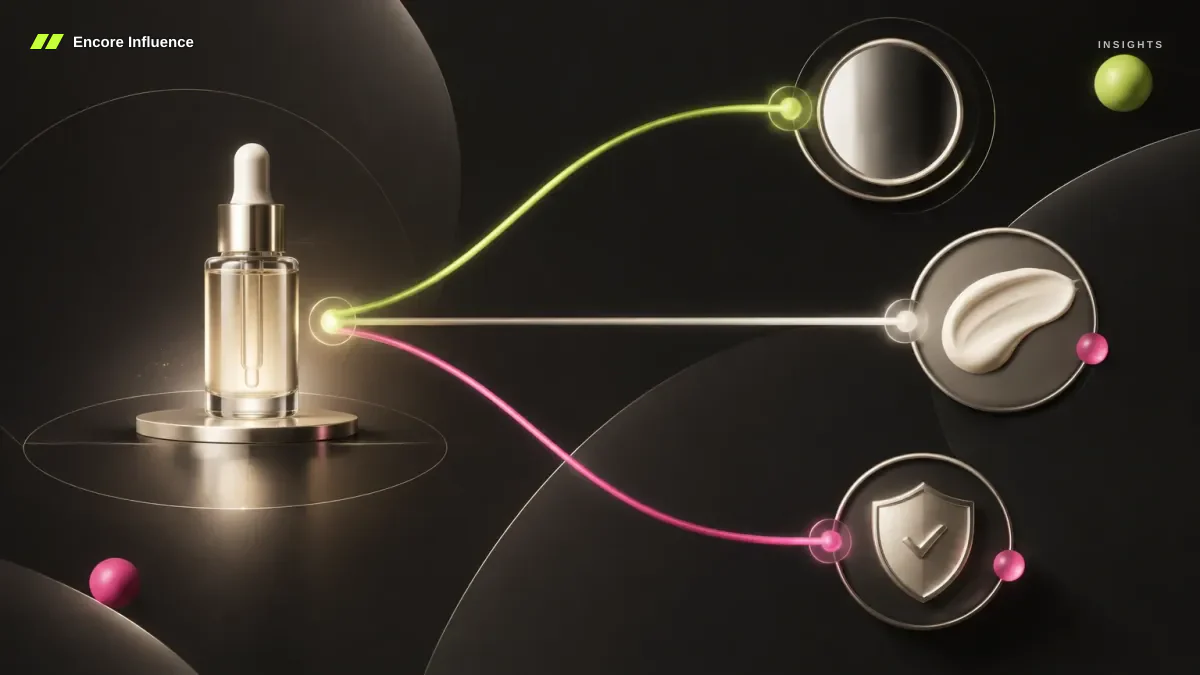
For beauty specifically, product fit matters because skincare, haircare, complexion, fragrance, and cosmetics do not ask the audience to process information in the same way. A simple lipstick launch may need different creator support than a multi-step routine or an ingredient-led serum. In practice, that means the launch brief should define the product’s main use case, the acceptable claims, the visual proof points, and any phrases the creator should avoid.
Claims control is also part of launch design. Do not treat it as a last-minute legal pass. Build it into the brief, the caption guide, on-screen text guidance, and final approval workflow. The launch team should know which statements are product facts, which are subjective opinions, and which require careful wording or removal. If the product is entering several overseas markets, this discipline becomes even more important because claims expectations and disclosure norms can differ by platform and jurisdiction.
Compliance is not optional. In the United States, influencers are responsible for making disclosures and complying with the FTC Endorsement Guides, and a relationship or material connection with a brand must be made obvious in endorsement messages. Source 1 That means the brand cannot assume the creator will handle disclosure correctly without a clear instruction set.
On TikTok, disclosure setup is also operationally specific. When content promotes a brand, product, or service, the commercial content disclosure setting must be turned on. TikTok says that if the proper disclosure is not shown, the post may be removed or restricted. Source 2 For a launch team, that means disclosure checks belong in the publishing workflow, not only in the legal review stage.
A practical launch framework for global beauty brands can be built in five steps:
-
Define the product job. Decide whether the launch needs awareness, education, trial, routine demonstration, or conversion support.
-
Assign creator roles. Match creators to each job instead of using the same profile type for every asset.
-
Lock the claims map. Write down approved claims, avoided claims, and language that needs legal or regulatory review.
-
Build the disclosure workflow. Confirm how disclosures will appear in captions, on-screen text, platform settings, and creator instructions.
-
Localize by market. Keep the product story consistent, but adapt language, proof points, and compliance checks to the market and platform.
A good overseas launch also needs a content mix that supports both trust and efficiency. One creator set can generate explainers and routine demos; another can provide social proof; a third can support paid amplification or retargeting if the campaign structure allows it. That does not require every creator to be high-cost or high-following. It requires a clear role design and a disciplined approval process.
When teams skip this structure, they often run into the same problems: creators emphasize the wrong benefit, claims drift across captions and videos, disclosure placement is inconsistent, and the brand cannot easily reuse content across markets. A launch framework prevents that by making product fit, creator role, claims control, and disclosure design part of the same plan.
If your team is comparing platforms, creator types, or regional execution paths, keep the same rule in mind: start with the product story, then decide who should say it, how it should be said, and what compliance steps must happen before publication.
Methodology and Limitations
This article is based on the approved source pack only. The verified external facts used here are limited to FTC disclosure guidance for U.S. influencer endorsements and TikTok’s commercial content disclosure instructions. Those sources support the compliance sections, but they do not prove beauty-specific creative benchmarks, audience preferences, conversion outcomes, or launch performance.
Where the article recommends a workflow, creator-role split, or launch sequence, those are practical planning recommendations rather than measured claims. No approved case evidence was supplied for this topic, so the article intentionally avoids case results and avoids promising ROI, sales, views, or virality.
Frequently Asked Questions
How do I choose the right creator type for a beauty launch?
Choose creator type based on the job the content has to do. If the product needs explanation, choose creators who can teach clearly. If it needs trust, choose creators who can demonstrate use or routine integration credibly. If it needs purchase support, choose creators whose audience and style fit the category and the market. The best creator is not always the biggest one; it is the one whose role matches the product story.
What is the biggest compliance mistake in creator launches?
The biggest mistake is treating disclosure as a minor caption detail. In the United States, the disclosure must be obvious when there is a material connection with a brand, and influencers are responsible for complying with FTC Endorsement Guides. Source 1 On TikTok, missing the commercial content disclosure setting can lead to removal or restriction. Source 2
Can one beauty creator brief work across all overseas markets?
One master brief can work as a starting point, but not as a universal final version. Keep the product story consistent, then adapt claims language, local context, and disclosure steps to the market and platform. That approach is more operationally realistic than trying to use one exact script everywhere.
What should be in a creator brief for beauty launches?
At minimum, the brief should include the product promise, the approved claims, the target audience, the content role, the must-use and must-avoid language, visual do’s and don’ts, disclosure instructions, and the review process. For regulated or sensitive launches, add a claims checklist and a local compliance review step.
Verified Sources
Key takeaways6 points +
- 01Start with product–creator fit, not follower count: the best launch match depends on the format of the product, the complexity of the routine, and the kind of explanation the audience needs.
- 02Separate creator roles by job to be done: seeding, education, proof, and conversion often require different creators, content angles, and approval levels.
- 03Treat claims control as a launch system, not a final review step; the brief, captions, on-screen text, and platform disclosures all need to work together.
- 04In the United States, influencers are responsible for making disclosures and complying with the FTC Endorsement Guides, and a material connection with a brand must be obvious in endorsement messages. [[SOURCE:src_c7e51948ff54]]
- 05On TikTok, when content promotes a brand, product, or service, the commercial content disclosure setting must be turned on; TikTok says missing disclosure may lead to removal or restriction. [[SOURCE:src_e8d45ee300f1]]
- 06For global launches, build one core operating framework and then adapt claims, language, creator types, and disclosure checks by market and platform.
+FAQ
Overseas creator discovery, answered clearly.
01What should a beauty brand decide before briefing overseas creators?+
Decide the product role first: is the creator meant to introduce the product, explain the routine, demonstrate use, validate performance, or drive action? That choice should shape the creator tier, content format, claims control, and approval process. For U.S. campaigns, the brand must also make sure disclosures are obvious and that the creator understands responsibility under FTC Endorsement Guides. [[SOURCE:src_c7e51948ff54]]
02Do disclosures need to be handled differently on TikTok?+
Yes. TikTok says that when content promotes a brand, product, or service, the commercial content disclosure setting must be turned on. TikTok also states that if the proper disclosure is not shown, the post may be removed or restricted. [[SOURCE:src_e8d45ee300f1]]
03Should brands use the same creator brief in every market?+
Use one master framework, not one identical brief. The core product story can stay consistent, but the exact claims, local language, disclosure language, and creator role should be adapted to the market and the platform rules that apply there. In the United States, the disclosure must be obvious when there is a material connection with a brand. [[SOURCE:src_c7e51948ff54]]
+Methodology
This article uses only the approved evidence in the source pack: FTC disclosure guidance for U.S. influencer endorsements and TikTok’s commercial content disclosure instructions. The strategic framework below is therefore an operational launch model, not a claim about measured performance. Where the article discusses budgets, sequencing, or creator-role mixes, those are practical planning recommendations rather than verified benchmarks.
+Limitations
The source set supports disclosure and platform-compliance requirements, but it does not verify beauty-category performance benchmarks, market-by-market creative preferences, product-category conversion rates, or case-study outcomes. The article therefore avoids guaranteeing results and does not include unverified platform or market claims beyond the supplied facts.
+Source basis
- Federal Trade Commission, Disclosures 101 for Social Media Influencers, publication date not stated: https://www.ftc.gov/business-guidance/resources/disclosures-101-social-media-influencers?wapp_id=289c098b-b15c-4bd0-9654-fa7b09ca2d13
- TikTok for Business, How to turn on the Commercial Content Disclosure setting in TikTok, announced 2026-01-01, effective 2026-01-01: https://ads.tiktok.com/resources/help/article/how-to-turn-on-the-commercial-content-disclosure-setting-in-tiktok